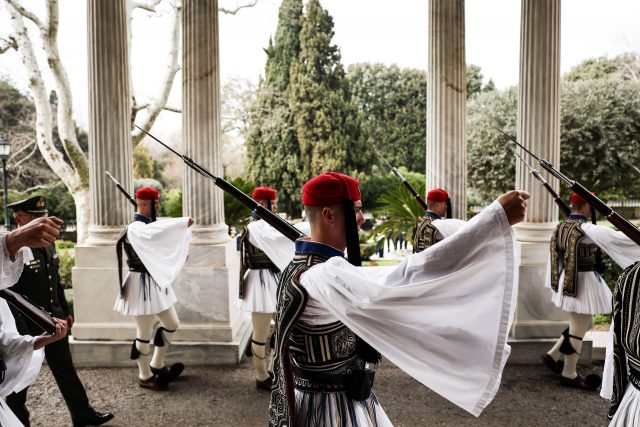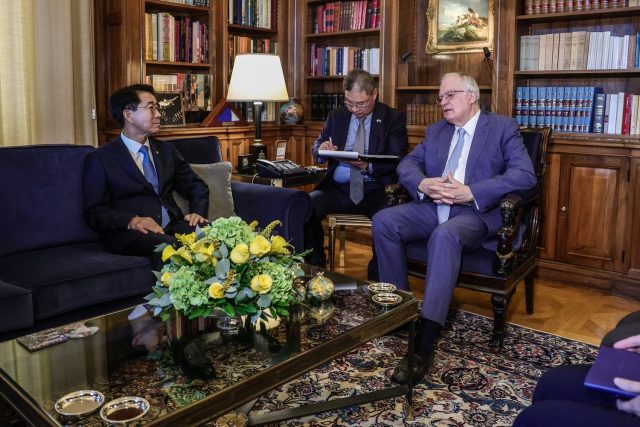
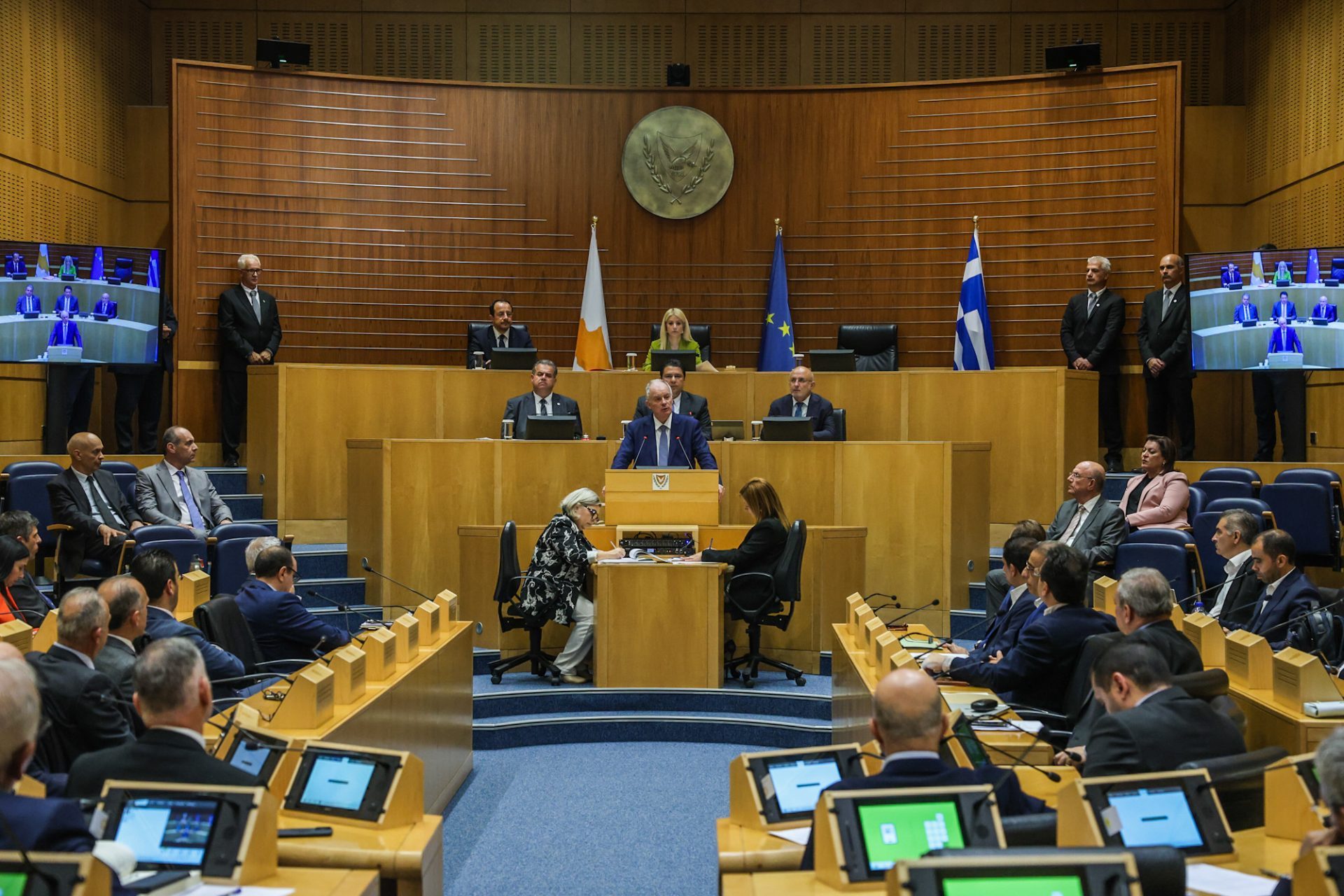
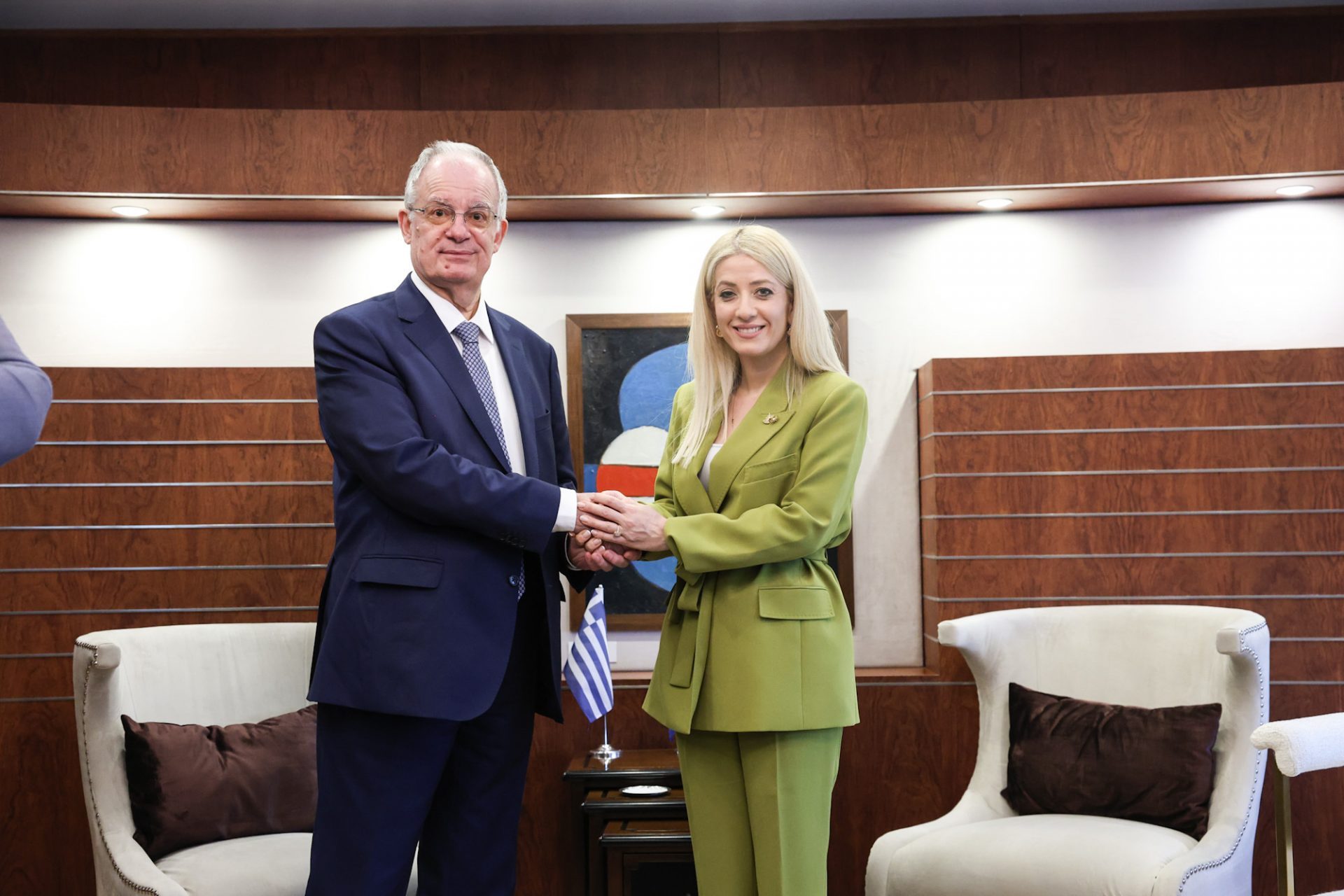
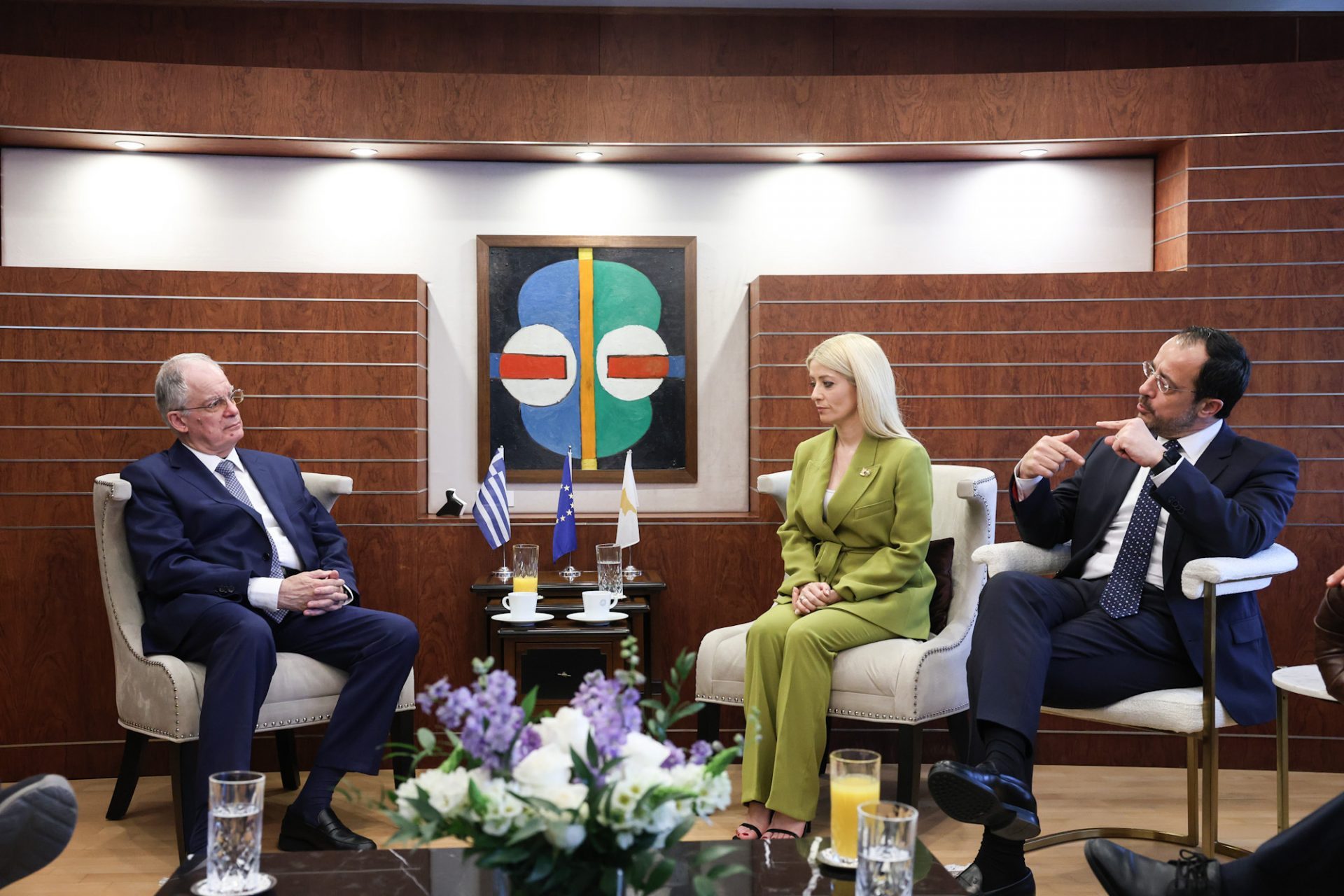
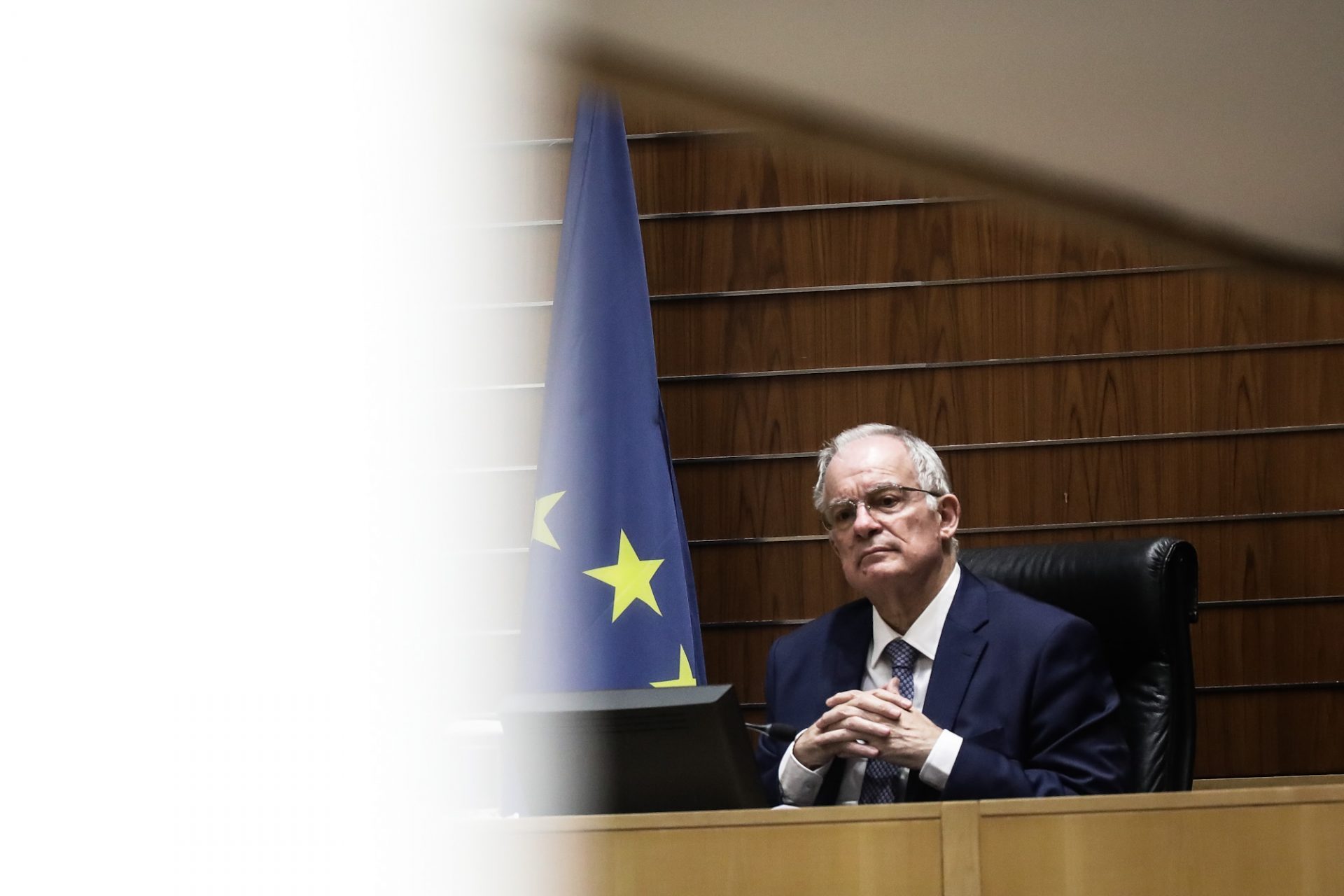
The President of the Hellenic Republic Constantine An. Tassoulas, visited the House of Representatives as part of his official visit to Cyprus, where he was received by President Annita Demetriou. After their meeting, Mr. Tassoulas addressed the plenary session of the House of Representatives of the Republic of Cyprus.
The speech of the President of the Hellenic Republic follows:
Mr. President of the Republic,
Madam Speaker of the House of Representatives,
Esteemed Members of the House of Representatives,
It is with deep emotion and great joy that I am back in Cyprus. This time as President of the Hellenic Republic, but with the same strong feelings that always pervade every Greek who visits the ancestral and living home of this part of Hellenism.
In Cyprus, the horizon of Hellenism is constantly “widening”, to recall the words of George Seferis, when on 12 March 1954 he wrote to his friend, the Cypriot painter Adamantios Diamantis, “Cyprus has widened the feeling I had for Greece”. And on 25 October of the same year, Giorgos Seferis, in a letter to his sister Ioanna Tsatsou, described his first impressions of Cyprus “…our young people would see from Cyprus a wider view of our land”, referring in this emotional way to Hellenism as a timeless, through the centuries, entity and wholeness, across and beyond borders.
The ties that unite us are long lasting and unbreakable. Our proximity is undisputed and diverse. Geographical, political, cultural. As Ioannis Kapodistrias said at the Poros Conference in 1828, addressing the representatives of the protecting powers, wishing to highlight this very proximity, “As for the islands, both History and the monuments of antiquity, all in unison testify that Rhodes, Cyprus and so many other islands are partitions of Greece”.
Expressing my pride for my presence here today, I would like to pay tribute, from this hall where the heart of the Republic of Cyprus beats, to the memory of the young Greek Cypriots who gave their lives in the national liberation struggle 1955-1959 to throw off the colonial oppression. It is in this framework that the recent decision of the Greek Government, whereby our schools in Greece jointly celebrated this year the 70th anniversary of the beginning of the Struggle, with events aimed at informing and raising awareness among the student community about this important chapter in the history of Cypriot Hellenism. We do not forget their sacrifice which contributed to the freedom of all Cypriots as well as to the establishment of the Republic of Cyprus, a member state of the United Nations and, for the past twenty-one years, of the European Union.
From this platform, I would also like to pay tribute to the memory of all the fighters who resisted the invasion of July-August 1974 with unparalleled courage, under the heavy burden of the criminal coup d’état that preceded it.
At this juncture, allow me to underline Greece’s continuing interest in the ongoing humanitarian issue of the Missing Persons. Fifty-one years after the Turkish invasion, the fate of more than 750 Greeks and Cypriots is still missing. The pain for these families remains unabated. We will not stop raising the issue of the Missing Persons and supporting efforts in every way possible until the fate of the last of them is determined.
Half a century has passed since the Turkish invasion of 1974 and more than one third of the territory of Cyprus remains occupied, while at the same time unacceptable claims are being made, outside the framework agreed for decades, for the resumption of negotiations aiming to find a mutually acceptable solution to the Cyprus issue. This is a hard truth. But it is, more accurately, only one side of the truth. The other side is the endurance of the Republic of Cyprus. Its refusal to accept and legitimize the fait accompli of the illegal military invasion and occupation. Its rapid reconstruction after the invasion, and its social, political and economic reconstruction, on the basis of which its accession to the European Union was achieved in 2004, with the contribution of Greece.
It is a true economic miracle that out of the ashes of the 1974 invasion and occupation, the economy of Cyprus has grown at an impressive rate throughout this period to date, ensuring progress and prosperity for its citizens. At the same time, the effective exercise of its sovereign rights is implemented through its commitment to international law and in particular to the Law of the Sea. The international relations of the Republic of Cyprus are being consolidated and strengthened, as is its role as a factor of stability and security in the Eastern Mediterranean region.
In this context, the deepening of its relations, including in the defense sector, with the United States of America, as well as with all the states of the Middle East, is indicative, proving that Cyprus, as Greece, remains a reliable partner and interlocutor.
At this point, I could not but underline the importance of trilateral and multilateral cooperation schemes, which make Cyprus and Greece bridges of peace and prosperity among Asia, Africa and Europe. These schemes, moreover, remain open to all neighboring countries, provided that they respect international law, including the law of the sea, and good neighborly relations.
More than fifty years of illegal military occupation is a long and unbearable time. Greece continues to proclaim in every direction that the only way to lasting peace in our region is a just, viable and effective solution to the Cyprus issue.
A solution that will permanently end the Turkish occupation and free the Republic of Cyprus and the Cypriot people from the occupying forces and from the anachronistic and unsustainable system of Guarantees and unilateral rights of intervention in Cypriot affairs. A solution that will guarantee the democratic rights and freedoms of all legal residents of Cyprus. A solution that restores the rights of displaced persons and their families. A solution that will ensure the smooth implementation of the European acquis throughout the territory of the Republic of Cyprus.
The only accepted basis for negotiations in order to find the desired solution is none other than the relevant UN Security Council Resolutions, including the most recent Resolution 2771/2025, for the unanimous adoption of which Greece, as a non-permanent member state of the Security Council, worked persistently and arduously and in close coordination with the Republic of Cyprus, last January.
The Security Council Resolutions call on all states to respect the independence, sovereignty and integrity of the Republic of Cyprus, condemn the illegal separatist entity in the occupied territories and call for negotiations to find a solution for a bizonal, bicommunal federation with political equality, one international personality, one sovereignty and one citizenship.
As we all know, the negotiations on the resolution of the Cyprus issue were suspended for several years following the Conference on Cyprus convened by UN Secretary General Antonio Guterres in Crans Montana in the summer of 2017. For more than seven years there has been no prospect of their resumption.
As a result, first and foremost, of the active and coordinated diplomacy of the Republic of Cyprus with the full support of Greece, the Cyprus issue is once again at the top of the United Nations agenda. At the informal multilateral meeting convened by the UN Secretary General in Geneva last March, it was agreed to discuss initiatives on important confidence-building issues and to follow up on the informal consultations, both in Cyprus and in the form of the expanded meeting. In the same spirit, I am confident that the appointment of Maria Angela Holguin Cuéllar as the UN Secretary General’s Personal Envoy for Cyprus will contribute in this direction. Any attempt to derail the established framework of the relevant UN resolutions is manifestly unacceptable and illegal.
Greece and Cyprus will continue to actively and fully support efforts to resume negotiations on a settlement of the Cyprus issue under the auspices of the UN Secretary General, as this is in the interest and well-being of all the people of Cyprus.
We have never accepted and we will never accept fait accompli. In spite of the times, we insist that violence and lawlessness cannot, under any circumstances, create law. Greece is and will remain a supporter and selfless national advocate of the Hellenic Cypriots, a firm ally and defender of the Republic of Cyprus. Greece and Cyprus will continue together in the struggle for peace, liberation and reunification of Cyprus.
I firmly believe that our commitment to this goal, until its final fulfillment, will unite, rally and mobilize all the forces of the Nation.
Thank you very much