




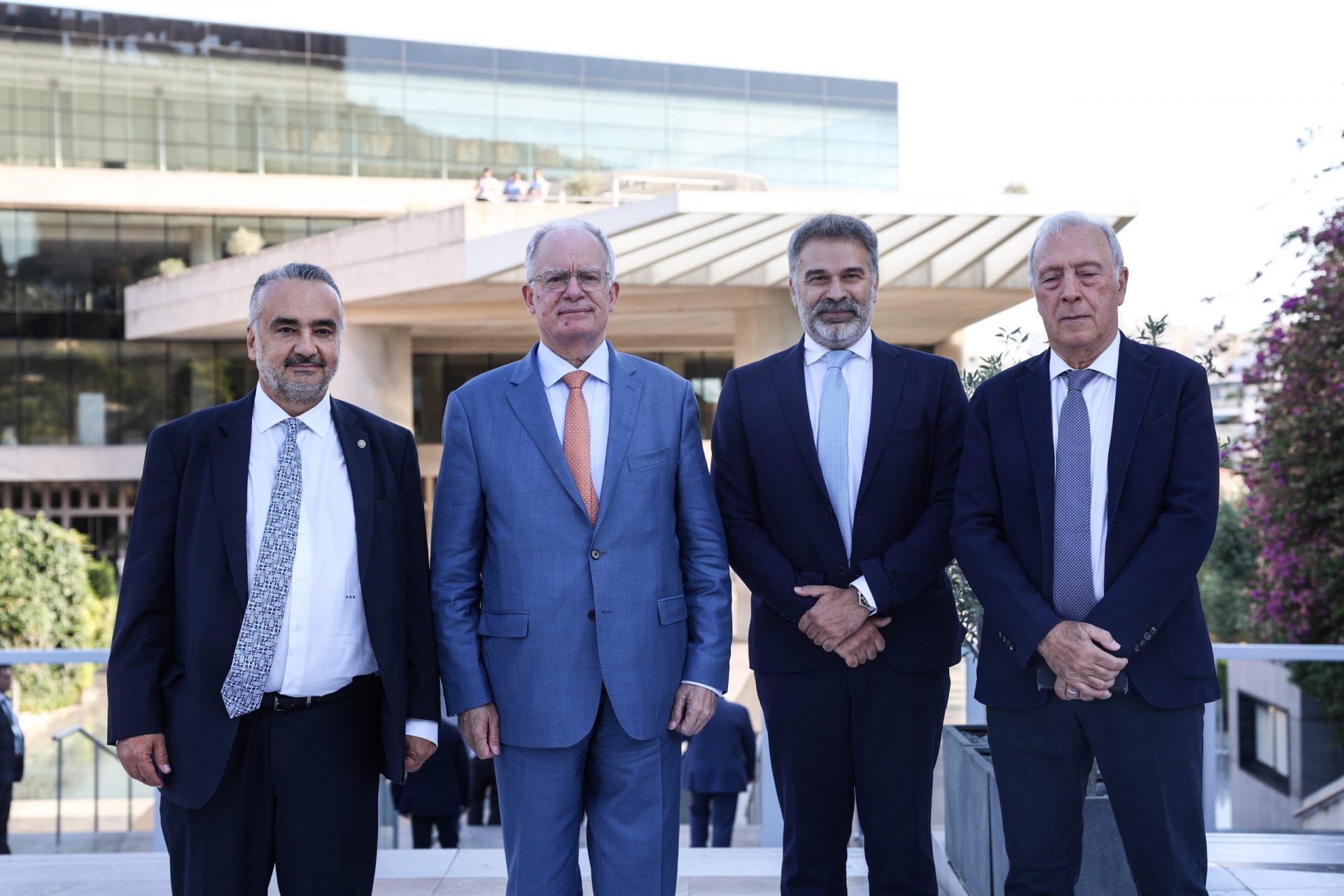
The President of the Hellenic Republic Constantine An. Tassoulas declared the opening of the works of the 1st Global Summit of Hellenic Lawyers and delivered the opening speech entitled “Safeguarding Democracy, Rule of Law and Justice – Global Challenges and the Role of AI”.
Mr. Tassoulas’ speech follows:
Distinguished Ladies/Distinguished Gentlemen,
It is with great joy that I address you today at the opening of the First Global Summit of Hellenic Lawyers. The realization of this initiative, which is the result of the excellent organization of the Plenary of Presidents of Greek Bar Associations, in cooperation with the Hellenic Australian Lawyers Association, the Hellenic Lawyers Association of New York and the Cyprus Bar Association, is a rare and valuable example of cross-border collaboration and marks the involvement of Greece’s legal community with the Greek lawyers of the diaspora and the Cypriot brothers towards a common goal: Safeguarding Democracy, the Rule of Law and Justice, during a period of global transitions and challenges.
The fact that the specific Summit is taking place in the land where Democracy was born, and aims to promote cooperation among lawyers of Greek origin practicing in different countries and legal systems, highlights the timeless universality of Greek values, reflects the depth of ties and the unity of Hellenism within and beyond national borders, and underscores our collective responsibility to ensure that the founding pillars of Democracy will continue to live and grow in every corner of the world.
As the Summit focuses on the timely and decisive impact of AI on Democracy, the Rule of Law and Justice, it opens a dialogue on whether technological development strengthens or threatens our democratic life.
The ability of AI systems to analyze vast amounts of data, make automated decisions and interact with people’s daily lives is both an opportunity and a challenge.
Undoubtedly, AI can serve to strengthen Democracy by providing new tools for consultation and facilitating the access of citizens to the public sphere and information. Moreover, the use of AI can also offer substantial advantages in the field of Justice. The processing of vast amounts of data can contribute to the statistical monitoring of the administration of justice, identifying delays, inconsistencies or structural distortions. It can also prove to be a valuable aid in speeding up the administration of justice, as it can facilitate the work of judges and lawyers through sophisticated tools for searching and indexing case law.
It becomes therefore evident that when AI is put at the service of the fundamental principles of the form of government and is framed by institutional guarantees, it does not pose a threat, but rather it strengthens the democratic function.
However, its very power and the speed of its spread make it necessary to be critically alert to the dangers it poses.
In this framework, the assessment of the relationship between AI and Democracy, the Rule of Law and Justice is a necessary duty for any State that wants to remain free, just and democratic.
AI is not a neutral technological tool. Algorithms embody values, choices and hierarchies of interests. In a pollical system of representative democracy, where accountability and citizen participation are pillars of legitimacy, the transfer of decision-making power to mechanisms that lack transparency and accountability creates rifts in the democratic architecture itself. The technological transfer of political will to entities that are invisible, uncontrollable and detached from the principles of political representation is certainly dangerous for the form of government.
Democracy, furthermore, does not simply presume freedom of expression. It presumes conditions of effective access to pluralistic, reliable and unbiased information. Without these conditions, is at stake the ability of citizens to decide freely, based on factual data and unaffected by algorithmically oriented influences. In an environment, however, where AI acts de facto as a ‘state factor’ by invading information structures and influencing what each citizen sees, how they are informed and to whom they pay attention to, the very basis of democracy – the free and rational shaping of political will – is called into question. All the more so, when AI is used to create ‘echo chambers’, the reinforcement of prejudices or even the construction of false representations through sophisticated technologies such as deepfakes, raising issues about the authenticity of the expression of the electoral will.
The Rule of Law, on the other hand, is not limited to legality, but incorporates transparency, accountability, protection of personal data, respect for individual rights, as well as mechanisms for the effective protection of the citizen against any arbitrary actions of the state authority.
But how can transparency, justification and scrutiny of administrative acts be ensured when they result from automated systems whose operation is not transparent, the origin is not known and the responsibility is not defined? The algorithmic determination of entitlements, the use of automated systems for tax or criminal checks raise crucial issues about the right of citizens to know by whom, why and according to which transparent, verifiable and sufficiently justified criteria their lives are affected by. Similarly, algorithmic control of actions or decisions requires new forms of institutional surveillance. Legality should not depend on the complexity of the code or the authority of the programmer. It must be reasserted through the guarantees of judicial control and the strengthening of mechanisms for transparent documentation of technological processes. In any case, it is vital for the survival of the Rule of Law to keep the human being at the center of public action, so as not to lead to a technocratic centralization.
Justice is the area where AI has already started to enter – with automatic case law analysis tools, “intelligent” decision prediction systems and automated dispute resolution processes.
At this point, however, we must be very careful. The administration of justice is not a technical task. It is the realization of human judgment and conscience on specific disputes through the legal evaluation of particular circumstances and the interpretation of legal rules based on the Constitution, laws and legal principles.
From this perspective, AI can provide tools, but it cannot substitute the human judgement. It can facilitate the administration of justice, but it cannot replace the legal judge. If we hand over the judicial function – even parts of it – to mechanisms without conscience, without empathy, without understanding of the principle of leniency and the principle of proportionality, and without an empirical perception of social reality, we risk building a shell of law, but devoid of the content of justice.
For lawyers, AI functions at the same time as a valuable tool and as a factor that progressively changes the nature of the profession. On the one hand, it offers important tools that can enhance their working conditions: automated legal research, writing drafts, rapid case law processing or the organization of huge volumes of documents help to save time and improve the quality of legal documentation. On the other hand, however, such an ease is accompanied by the risk of losing a crucial skill: that of deep, systematic legal research and complex analytical reflection, which is an identity element for the legal profession. Indeed, in this fast-paced age, it is no coincidence that the oversupply of immediate, and often superficial or incorrect answers, is leading more and more citizens to seek legal advice not from a lawyer, but from digital platforms or automated tools. Thus, the lawyer’s job often ends up being the deconstruction of myths and misconceptions created by these tools. At the same time, the entry of AI in the Administration and Justice in the form of automated decisions confronts the lawyer with new challenges: he or she must be able to identify when such a decision lacks sufficient justification, question its legitimacy and ensure that technology does not substitute the institutional guarantee of human judgment.
Therefore, the lawyer of tomorrow, will not be less necessary; but he or she will be necessary in different terms, in a world where technology is redrawing the boundaries of responsibility and of legal practice itself.
In this fluid landscape, where technology is transforming the global activities, legal science cannot afford to remain an observer. It must formulate institutional and regulatory tools and ensure that technological innovations are in accordance with the fundamental values of Democracy, the Rule of Law and Justice. Let us therefore use this Summit as an opportunity to exchange experiences, to draw up a common strategy and to demonstrate that our fellow compatriots in the legal profession, both inside and outside Greece, remain determined to defend these fundamental values with institutional boldness, technological education and international cooperation.
With these thoughts and expectations, I now declare the opening of the Summit and wish you successful and productive works.