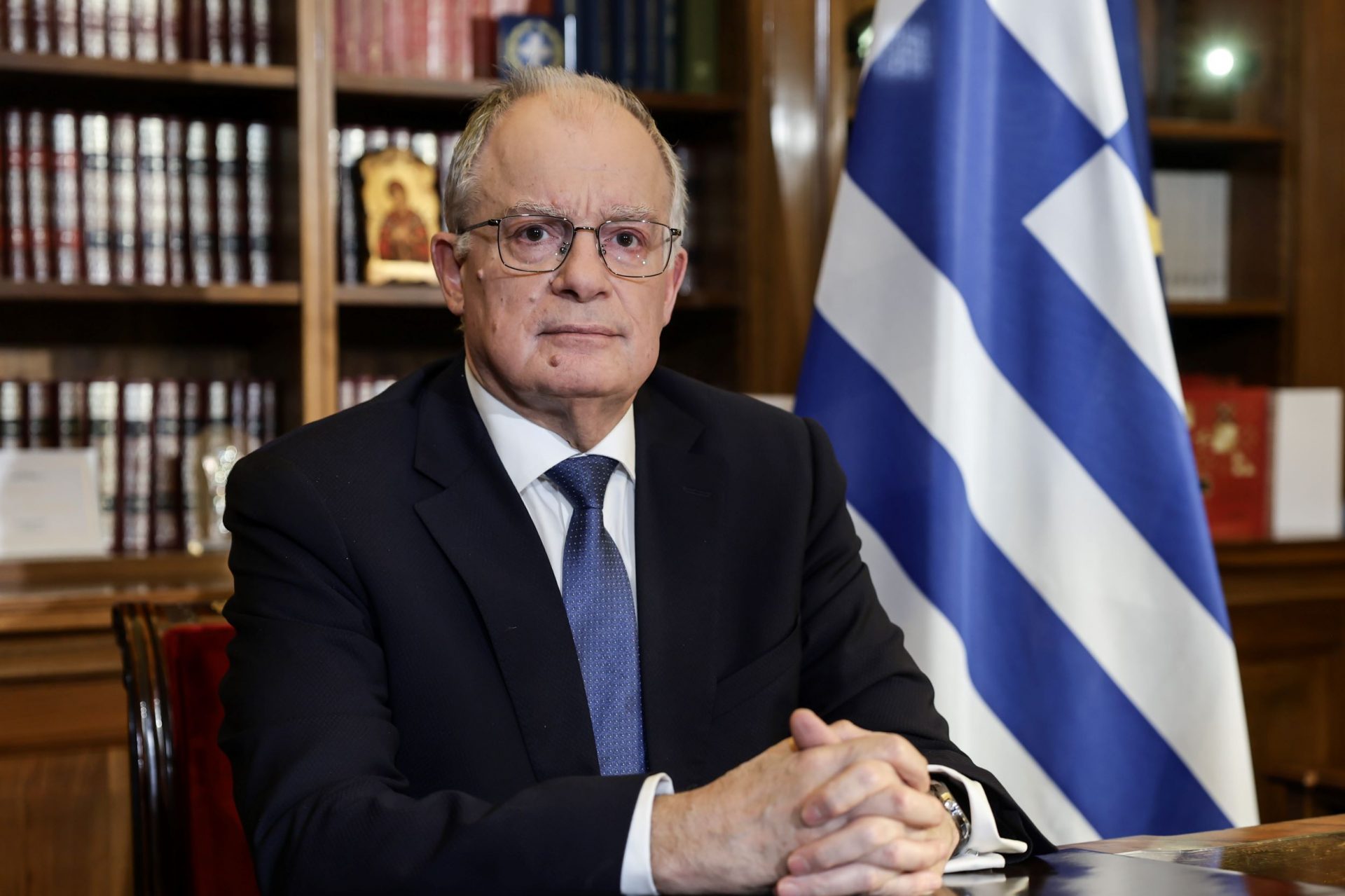
The President of the Hellenic Republic Constantine An. Tassoulas delivered a greeting, via video message, at the event celebrating World Greek Language Day, organized by the Hellenic National Commission for UNESCO today in Paris.
Mr. Tassoulas’ greeting follows:
“The establishment of February 9 as World Greek Language Day by UNESCO, within the framework of its commendable effort to promote international understanding through highlighting the value of cultural expressions such as the language, is not a mere symbolic act. It is a recognition with deep cultural, historical and educational content, which explicitly emphasizes the role of the Greek language as the foundation of global thought and a living tool of expression for a people with a longstanding continuity. As a historical rooting and, at the same time, as a universal good.
Language is the most irrefutable witness to the historical consciousness and historical continuity of the Greeks. The Greek language is among the few in the world that show an uninterrupted historical presence in spoken and written form for forty centuries. It is a life-giving river that flows from the Homeric epics to our own days, carrying ideas, values and ways of seeing the Other and the World. In its vocabulary, syntax and grammar, are imprinted the transformations of a civilisation that shaped the European identity: It offered the world the first principles of philosophy and science, developed theater as a social institution and historiography as a reflection of human action and, above all, laid the foundations of democracy. With its precision, its ability to form abstract concepts and express subtle nuances and its robust plasticity, it enabled the development of argumentation, debate, logical analysis and persuasion, it invented the words that expressed the basic concepts of democracy—polis, citizen, law—and consolidated its practice through Logos (reasoned discourse). It is no exaggeration to say that democracy was born within language. The Greek language occupies a dominant position across historical time as a catalyst for the development of the linguistic phenomenon and subsequently of the structured thought in all facets and manifestations of Western civilization, centuries before Rome and to the present day. This fact prompts us to reflect on the benefits that young people in every country today may have from the return of the teaching of ancient Greek. In a world where the concepts of democracy, truth and measure, as well as structured thinking, are being tested again, the return to ancient Greek can ensure greater visibility and more understanding on the road to the future.
It would be common ground to be reminded that the Greek language may be spoken by few, yet it extends its roots into all the languages of the Western world, like thin veins that feed the contemporary thought. A treasure trove of terms for every science and concepts for every intellectual adventure, the Greek language, despite the dominance of English, remains an active feeder of contemporary terminology. And this is precisely what UNESCO’s proclamation of February 9 as World Greek Language Day signifies: the recognition that the Greek language does not belong only to the Greeks, but it constitutes a global cultural heritage that continues to offer tools for understanding human nature and our complex world.
Historically, the Greek language occupies a prominent position in intellectual thought, linguistic expression and in the formulation of fundamental concepts and words of the European and broader intellectual world, which are expressed, received or traced back to words and concepts of the Greek language. To us Greeks, however, this symbolic gesture by UNESCO, doubly symbolic as it is celebrated on the day marking the death of our national poet Dionysios Solomos, apart from pride, it also engenders a sense of responsibility. It affirms the indisputable truth that our language is a treasure that continues to shine because it continues to generate meaning in the present. It is an invitation to care for it, to excavate its rich deposits and put them to use today, bringing to light its inherent flexibility and adaptability, to pass it on to future generations, to share it and spread it. It is, finally, an imperative, which converges with the invaluable phrase of Dionysios Solomos: “I have nothing in my mind but freedom and language.” A phrase that reminds us that our language is far more than a system of signs. It is an instrument of relationship, an expression of community and, above all, a factor of inner and outer freedom.
It is this language that the poet Odysseas Elytis spoke of in Stockholm in 1979, where he was awarded the Nobel Prize in Literature.
He said: “Here I am today, at the station in Stockholm, with the only capital in my hands, a few Greek words. They are few but alive, as they are on the lips of an entire nation. They are three thousand years old, but cool and fresh, as if they had just been drawn up from the sea. Among the pebbles and the seaweed from the shores of the Aegean. In the bright blue and the absolute transparency of the ether. It is the word “sky,” it is the word “sea,” it is the word “sun,” it is the word “freedom.” I place them with respect at your feet. To thank you. To thank the noble people of Sweden and its leaders, who, opposed to the quantitative assessment of values, preserve each year the mystery of the renewal of the miracle. Τhank you”.