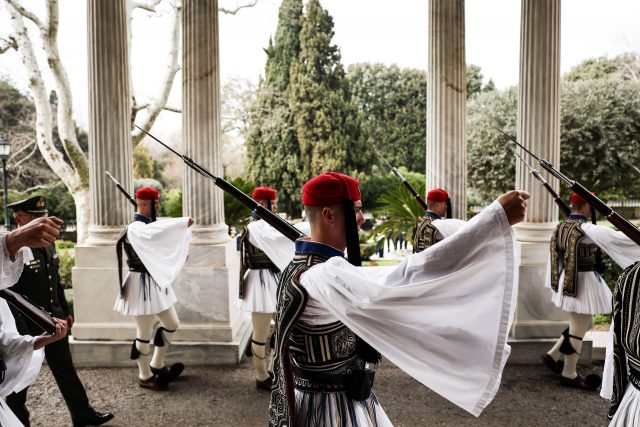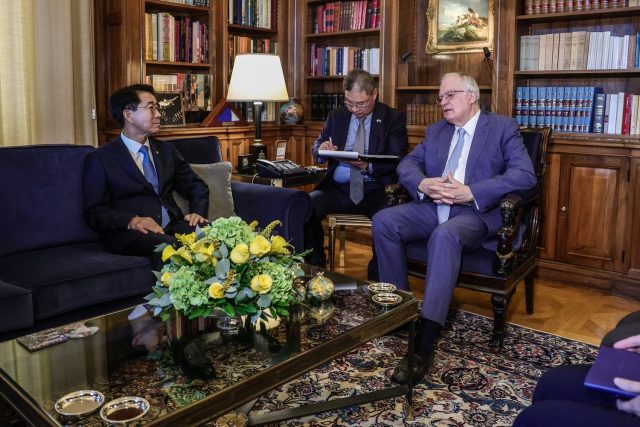
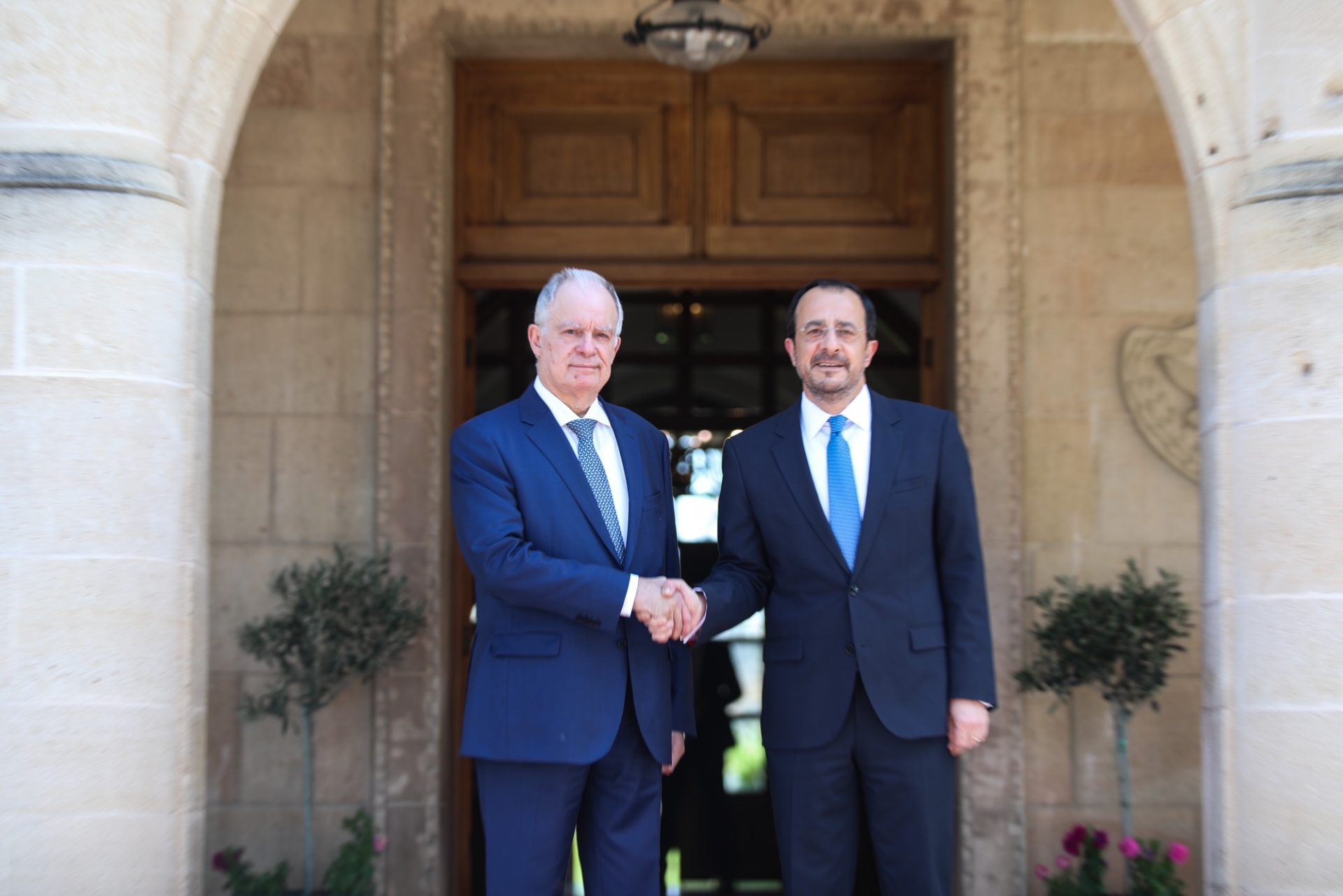
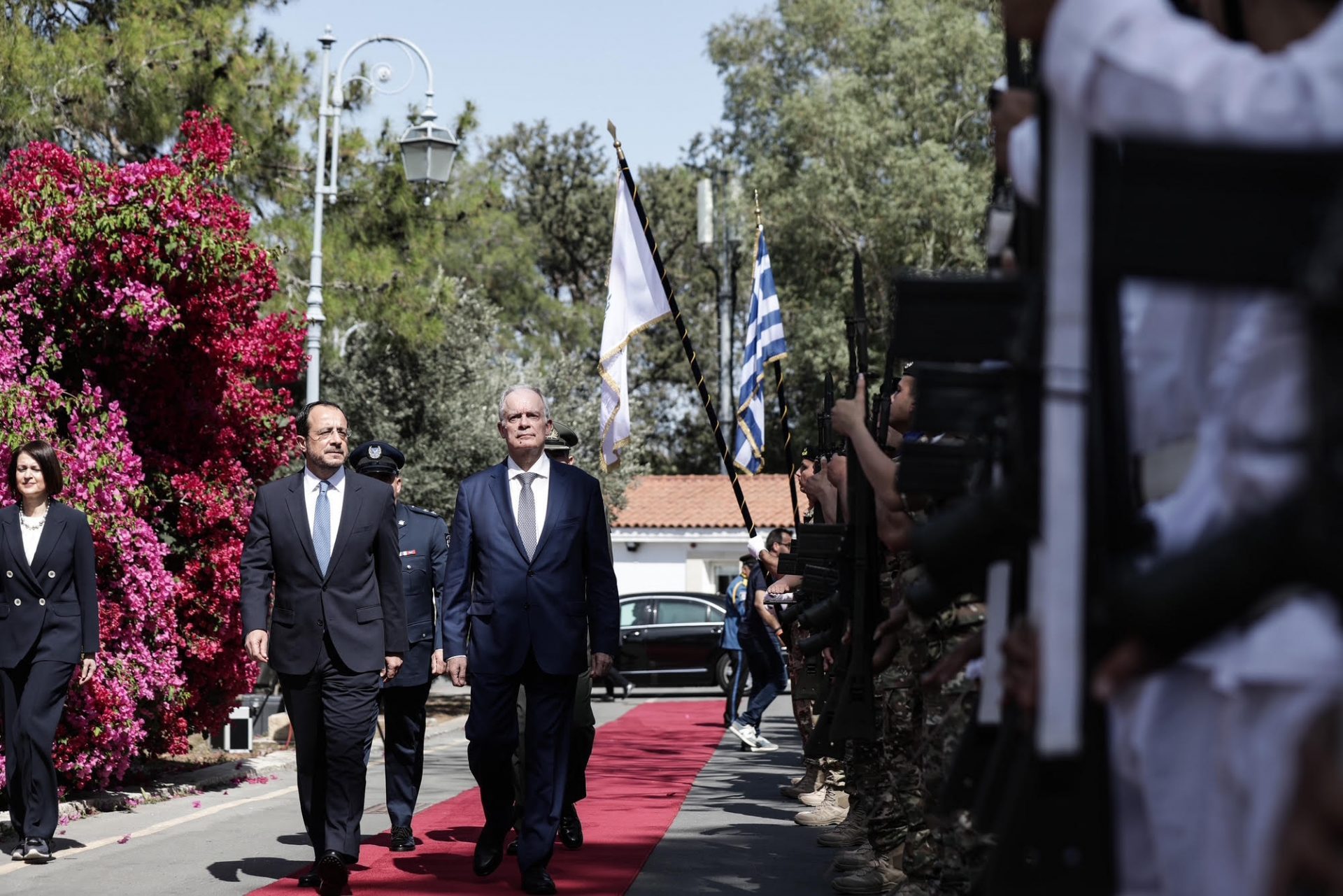
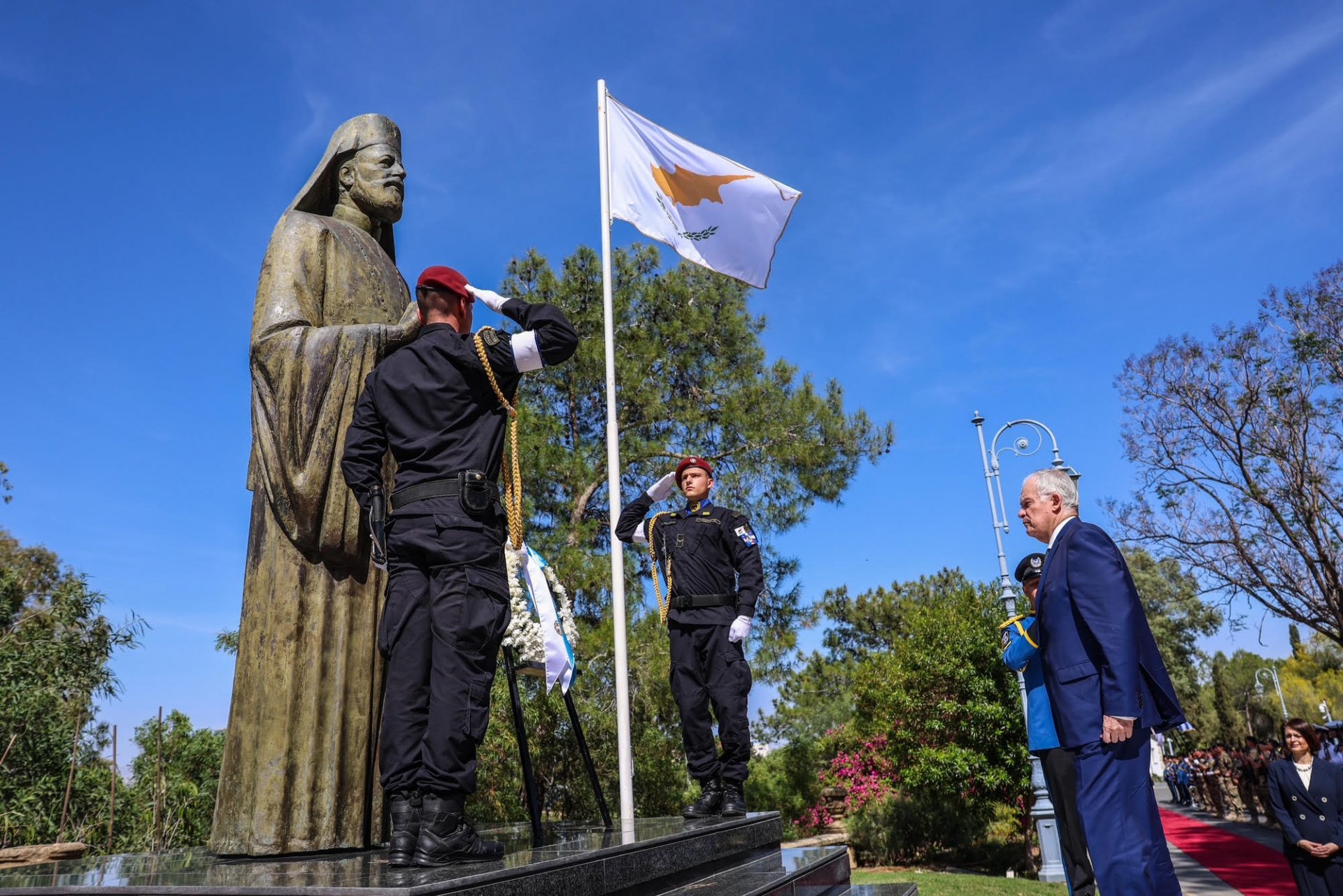
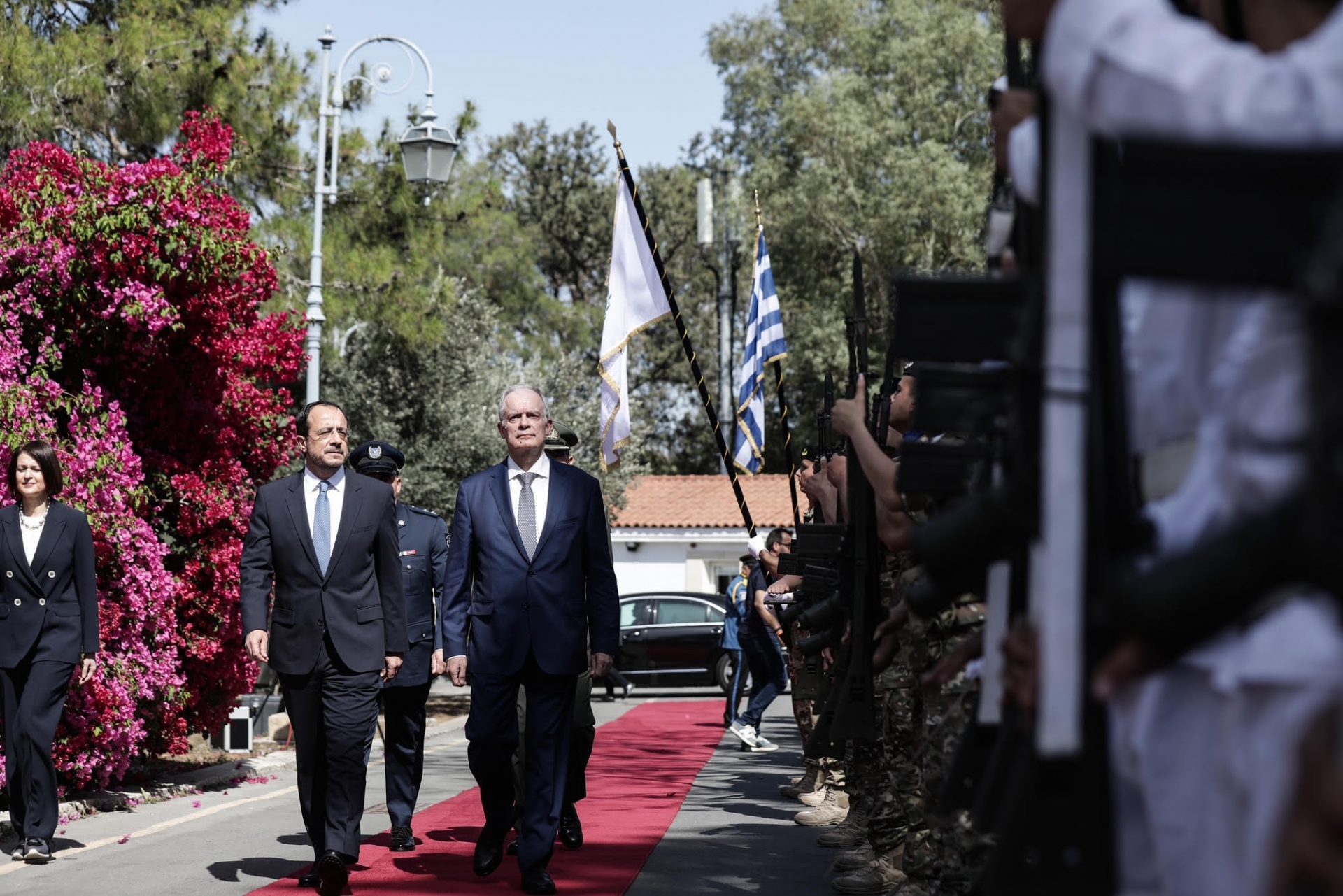
The President of the Hellenic Republic Constantine An. Tassoulas starts today a three-day official visit to Cyprus, at the invitation of the President of the Republic of Cyprus, Nikos Christodoulides.
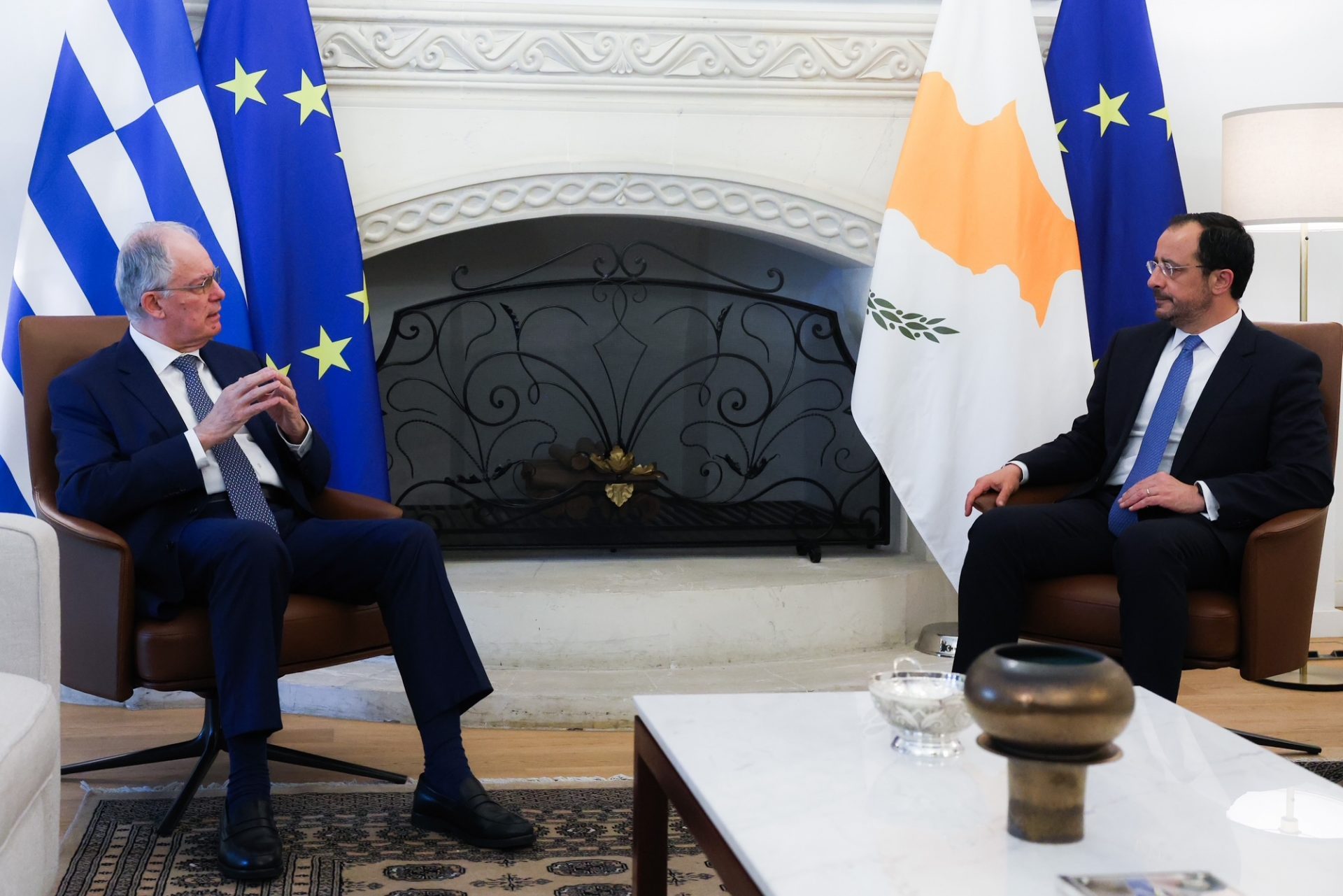
After the welcoming ceremony, the two Presidents had a private meeting at the Presidential Palace, followed by extensive talks between the delegations.
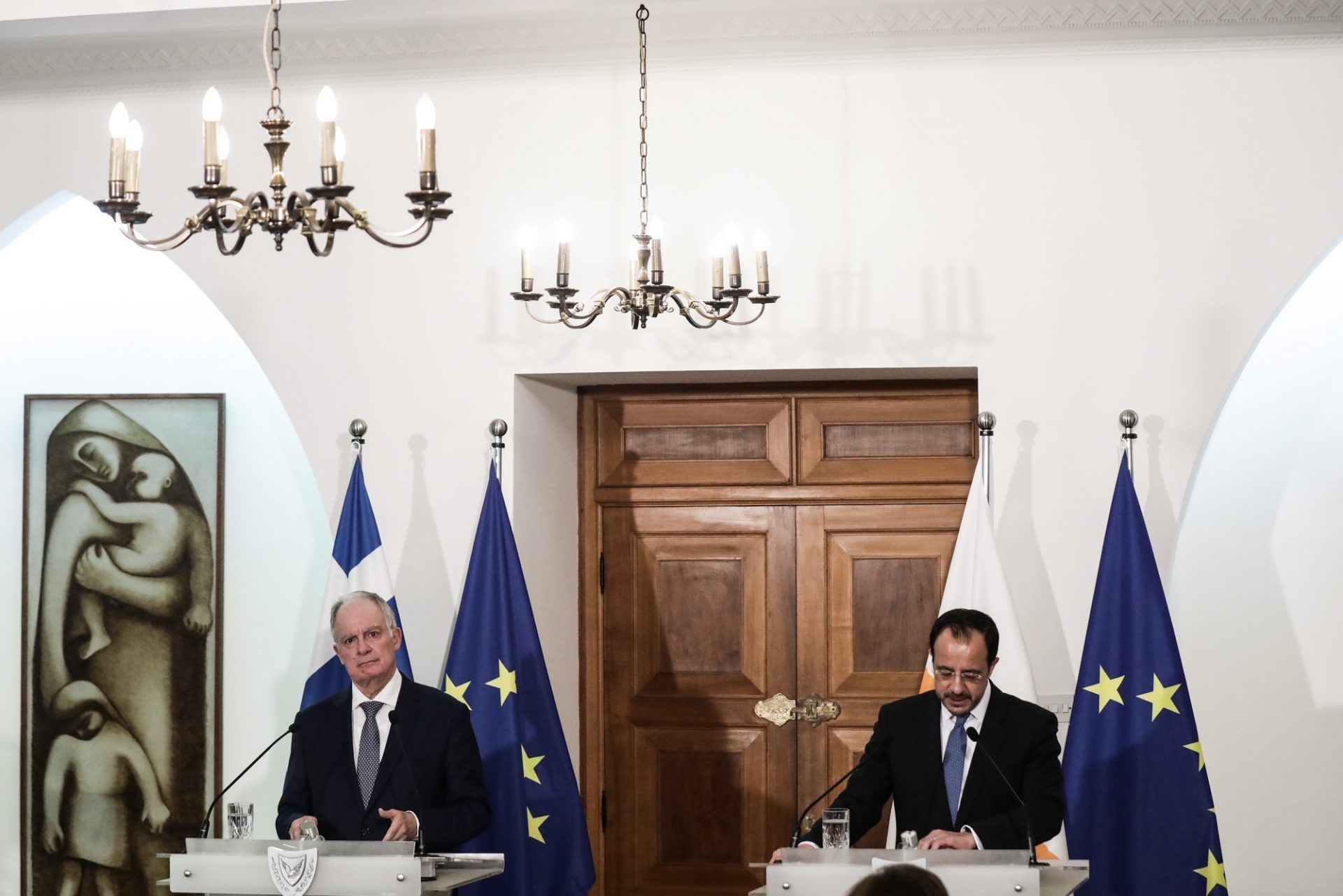
At the joint press conference, Mr. Tassoulas made the following statement:
“Mr President of the Republic of Cyprus, dear Nikos, thank you for your very kind words and for the warm welcome you have given me.
The fact that the first official visit abroad by the current President of the Hellenic Republic is customary to take place in Cyprus, and vice versa of course, is not just a matter of etiquette. It reflects, symbolically, as you rightly said, but also on a substantive level, the utmost importance that the Hellenic State attaches to the close relations and cooperation with the Republic of Cyprus, and in particular to the unbreakable, long-standing ties between the people of Greece and the people of Cyprus.
It is therefore with great pleasure and great emotion that I am in Cyprus today, on my first official visit as President of the Hellenic Republic, in order to convey and express the feelings of love and solidarity of the Greek people towards the Cypriot people.
In difficult and unpredictable times, in a rapidly changing international environment, where realities can change even every day, unfortunately usually for the worse, where decades of stability are challenged and crises follow one another, the forces of Hellenism can only stand united, defending their rights and interests with realism and confidence. We must never forget that when we stood united and worked together, we achieved important victories, such as the accession of Cyprus to the European Union.
And thus today, Greece and Cyprus, Cyprus and Greece are talking with sincerity and cooperating perhaps more closely than ever before, increasing together and multiplying their geopolitical stature, their geopolitical impact. This was the conclusion we reached together with the President of Cyprus during the particularly constructive talks preceded our meeting.
Our two countries, as equal members of the European Union and reliable partners, both bilaterally and in regional, trilateral and multilateral cooperation schemes, are pillars of stability and security in the troubled Eastern Mediterranean region, constantly strengthening their voice and their power.
Of course, we discussed with President Christodoulides the latest developments on the national issue, following the informal multilateral meeting in Geneva and his recent meeting with the leader of the Turkish Cypriot community. In this context, I welcomed the appointment of the UN Secretary General’s Personal Envoy, Mrs. Olgin, which proves that, despite any attempts to create new fait accompli, the Cyprus issue has been dynamically returned to the UN agenda.
I would like to take this opportunity to reiterate that Greece remains an unwavering supporter of the Republic of Cyprus in its peaceful struggle for the end of the illegal Turkish occupation and the reunification of Cyprus into a European and democratic state, fully respecting the rights and freedoms of all its legitimate residents.
With President Christodoulides, we agreed that the only way forward is the resumption of talks, with the aim of finding a just, viable and functional solution to the Cyprus issue within the framework of the UN Resolutions and the European acquis.
A solution that will forever free the Republic of Cyprus and its people from the occupation troops and from the highly anachronistic system of guarantees and intervention rights. A solution of a bizonal, bicommunal federation with one sovereignty, one international identity and one citizenship.
We will not tire of repeating the obvious until the final vindication. The violation of the fundamental principles of the United Nations Charter, the use of armed force, the occupation of territory and the violation of human rights can never bring justice and therefore can never be accepted. Thus, the divisive or separatist rhetoric of a ‘two-state solution’ can only be rejected.
We also agreed that maintaining channels of communication between Greece and Turkey could potentially contribute to creating conditions for the resumption of the dialogue on the Cyprus issue, provided of course, provided of course, I repeat, that the other side avoids any action to create fait accompli, as was attempted during the recent presence of the Turkish President.
Both Turkey and the Turkish Cypriot side must understand that the path of their European course, prosperity and development passes through respect for international law and the demolition of the last wall that divides a European capital.
A European capital of a country, Mr President, that will preside over the Council of the European Union in the first half of next year on what you have very aptly described as a national mission.
We therefore expect the other side to seize the opportunity to demonstrate the required constructive attitude in order to restart the negotiation process, without preconditions and ultimatums.
In addition to the national issue, President Christodoulides and I exchanged views on our bilateral cooperation, which spans a wide range of areas, from defence and energy to education, civil protection and health. I was also informed with great satisfaction about the latest developments following the second Greek-Cypriot Intergovernmental Summit, which took place in Nicosia a few months ago, which is the culmination of the efforts of the two Governments to produce tangible results for the benefit of our peoples, as another example I would like to mention, in the field of cooperation in higher education.
We had the opportunity to discuss international and regional developments that affect our geopolitical environment.
In this context, the President briefed me on his recent trip to the Middle East. We share your concern at the possibility of a further escalation of tensions, as well as your recognition of the need for a rapid ceasefire, the resumption of humanitarian aid to Gaza, to which you and Greece have contributed, and the resumption of the search for ways to release all hostages without exception. Only then will it be possible to create the conditions for a political horizon aimed at a two-state solution in accordance with UN resolutions. That was also my message to the President of Egypt at the meeting I had with him this morning in Athens, the content of which I conveyed to the friend, the President of Cyprus.
Similarly, we agreed on the need to continue supporting Ukraine, as well as the peace efforts, always with respect for the rules of international law and without ignoring the will of the Ukrainian people.
We share the view that the rapid geopolitical developments and restructuring underline the need to strengthen European strategic autonomy and to promote plans for a common European defence, but in a way that takes into account the security interests and concerns of all states without exception.
Mr. President,
In closing, allow me to point out that beyond our intergovernmental cooperation or our joint participation and action in international and regional organizations and schemes, the aspects that deeply bind Greeks and Cypriots are none other than our common language, our historical roots and our culture. And I am referring to a recent very important and very welcome news from Unesco which voted and decided to dedicate the World Day of the Greek language on the 9th of February, the day of the death of the national poet Dionisios Solomos. This heritage of the language of our historical roots and our culture, this heritage we all ought to preserve and pass on to future generations of Greeks.
As you are well aware, Greece will not cease to stand by your side. Together we will continue to fight for peace, freedom and prosperity of the Cypriot Hellenism. Cyprus, Mr. President, I can assure you, will always be in the heart of each of us. And this is the message I am delivering here today.”
Answering a journalist’s question about the room for optimism for the expanded meeting under the UN Secretary General next July, given the positions expressed by the Turkish leadership, Mr. Tassoulas, among other things, stressed:
“Listen, it’s not a matter of optimism or pessimism. It is a matter of understanding the context in which the resumption of talks is taking place. This framework has been defined by the United Nations. It is a framework that the European Union explicitly supports and is involved in. And this framework has to do with a completely different premise from the monotonous and lonely internationally, I would like to say, view that you mentioned just now about the ‘two states.
What we are talking about here is a recognition that this is an international issue of illegal invasion and occupation that needs to be addressed. And we also have to address it as a European question, as a European issue that concerns Europe.
Therefore, I believe that, being united, being optimistic, being ambitious that what is happening today is not going to be the eternal, the permanent fate of Cyprus, I would dare to say to you – to answer your question – that yes, finally I am optimistic that one world, which is plagued by revisionism, which is plagued by violations of international law, a world which is plagued by an uncertainty, this world is waiting for solutions which will not reward what it is plagued by”.
Earlier, at a special ceremony, Mr Christodoulides presented the President of the Republic with the ” Grand Collar of the Order of Makarios III”.
The President of the Hellenic Republic is accompanied by the Deputy Minister of Foreign Affairs Ioannis Loverdos.